Randomized Matrix Approximation
1 Why low rank is everywhere
Matrices distilled from the physical world — discretized operators, image stacks, term-document counts, recommendation feedback — rarely have numerically full rank. Their singular values decay, and decay fast, which by the Eckart–Young theorem means a rank-k surrogate with small k already carries nearly all the information.
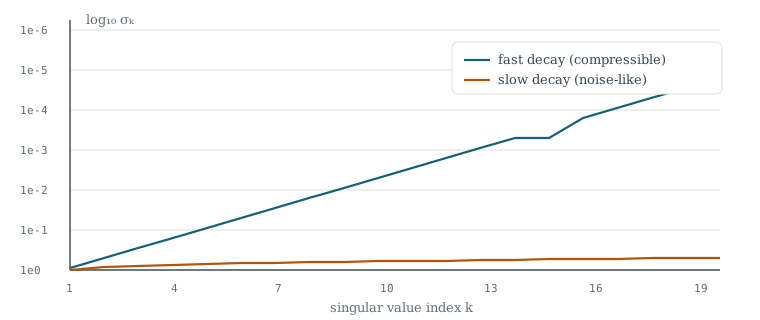
Figure 1. Two singular value spectra on a log scale. Fast decay (blue) makes the matrix compressible; slow decay (amber) is essentially noise-like and resists approximation.
Classical dense SVD algorithms cost O(mn·min(m,n)) — and they insist on touching every entry, even though the answer is determined mostly by a low-dimensional subspace. The randomized paradigm asks a cheaper question first: can we find the dominant subspace with a handful of random sketches, and only then run an expensive deterministic procedure on a much smaller matrix?
2 The randomized range finder
The core algorithm is four lines. Fix a target rank k and an oversampling parameter p (say p = 10):
draw an n×(k+p) standard Gaussian matrix Ω
form the sketch Y = A Ω                      (k+p matrix–vector products)
orthonormalize: Q = orth(Y)
return Q   — approximately, range(Aᵣ) ≈ range(Q)
The intuition is sampling theory in disguise: a Gaussian random combination of the columns of A almost surely retains every direction the matrix cares about, with weights proportional to that direction's energy. Any subspace that captures significant singular energy is likely to appear in the sketch; directions with tiny σi may be lost, but by definition they barely matter. The deterministic postprocessing — project, form the small QTA, and take its SVD — costs O(mn(k+p)), a factor min(m,n)/(k+p) cheaper than the full decomposition.
3 Oversampling and power iteration
Two knobs control quality. Oversampling (p extra samples) protects against the randomness of the last few captured singular directions — the tail is where sketch variance concentrates. Power iteration replaces Y = AΩ by Y = (AAT)qAΩ, which sharpens the spectrum by raising each singular value to the power 2q+1: gaps that were modest become decisive. In practice q = 1 or 2 suffices, provided each application is re-orthonormalized to fight rounding error — otherwise the scheme quietly degenerates toward the dominant singular triplet.
4 Error guarantees
The advertised accuracy is not folklore. For the prototype estimator the average-case analysis is exact.
Read the bound pragmatically: when there is a spectral gap at k, the scheme delivers accuracy ≈ σk+1 — the best a rank-k approximation can do anyway — with probability overwhelming for practical purposes.
5 Numerical observations
The table below records a small reproducibility study on dense matrices with synthetic fast decay (generated as U diag(σ) VT with σj = 2−j, plus additive noise), comparing classical dense SVD against the randomized scheme with q = 1. Numbers are medians over 20 trials, single core, double precision; they are illustrative rather than benchmark-grade.
| size m×n | rank k | dense SVD (s) | randSVD (s) | ‖Â−A‖F/‖A‖F |
|---|---|---|---|---|
| 4 000 × 2 000 | 40 | 14.8 | 1.9 | 1.2e−6 |
| 8 000 × 4 000 | 60 | 67.3 | 6.8 | 1.5e−6 |
| 16 000 × 8 000 | 80 | 291.5 | 25.1 | 1.7e−6 |
6 Open directions
- Single-pass algorithms. Streaming settings (data observed once) call for updates that never revisit the matrix; current schemes trade accuracy for the pass constraint.
- Structured test matrices. Gaussian sketches are convenient to analyze but SRFT / sparse random projections are several times faster at equal accuracy.
- Adaptive rank estimation. Choosing k on the fly, with certified error, remains more art than the theorems admit.
- Tensors and kernel matrices. The same sketch-and-solve philosophy — random embeddings first, exact algebra second — is being exported well beyond matrices.
References
- N. Halko, P.-G. Martinsson, J. A. Tropp, "Finding structure with randomness: probabilistic algorithms for constructing approximate matrix decompositions," SIAM Review 53 (2011), 217–288.
- E. Liberty, F. Woolfe, P.-G. Martinsson, V. Rokhlin, M. Tygert, "Randomized algorithms for the low-rank approximation of matrices," PNAS 104 (2007), 20167–20172.
- P.-G. Martinsson, J. A. Tropp, "Randomized numerical linear algebra: foundations and algorithms," Acta Numerica 29 (2020), 403–572.
- F. Woolfe, E. Liberty, V. Rokhlin, M. Tygert, "A fast randomized algorithm for the approximation of matrices," Appl. Comput. Harmon. Anal. 25 (2008), 335–366.