Krylov Subspace Methods
1 Krylov subspaces
When a matrix is available only as an operator — a routine that returns Av — direct factorizations are out of reach. The only information one can gather is a sequence of matrix–vector products starting from a right-hand side b, and the natural space they span is
The name is honest history: A. N. Krylov used exactly such a chain in 1931 to hand-compute the oscillation frequencies of a ship. By Cayley–Hamilton the sequence stalls at the degree of the minimal polynomial — and if that degree is small, the exact solution A−1b already lies in a modest Krylov space. Sparse systems that arise from discretized PDEs and networks are frequently of exactly this kind.
2 Arnoldi and Lanczos
Orthonormalizing the chain gives the Arnoldi process: a sequence q1, q2, … with
where Hk is upper Hessenberg. When A is symmetric, Hk collapses to tridiagonal — three-term recurrences, hence the Lanczos process, whose cost per step is one matrix–vector product and O(n) work. The eigenvalues of the small Hk (Ritz values) approximate the extremal eigenvalues of A astonishingly quickly, which is why Lanczos remains the workhorse for large symmetric eigenproblems.
3 Conjugate gradients
For symmetric positive definite systems, Hestenes and Stiefel (1952) turned the Lanczos process into a direct solver that behaves like an iterative one: minimize the A-norm of the error over each Krylov space, in closed form.
r₀ = b − Ax₀;  p₀ = r₀
for k = 0, 1, 2, …
    α   = (rᵣᵗ rᵣ) / (pᵣᵗ A pᵣ)
    xᵣ́₁ = xᵣ + α pᵣ
    rᵣ́₁ = rᵣ − α A pᵣ
    β   = (rᵣ́₁ᵗ rᵣ́₁) / (rᵣᵗ rᵣ)
    pᵣ́₁ = rᵣ́₁ + β pᵣ   until ‖rᵣ́₁‖ small
Two scalar axpys and one matrix–vector product per step; no factorization ever touches A. Conjugate directions are mutually A-orthogonal, and after at most n steps the exact solution appears (in exact arithmetic). In practice one stops tens or hundreds of steps early.
4 Convergence theory
The bound is conservative — CG converges according to the distribution of eigenvalues, not merely the ratio λmax/λmin; isolated extreme eigenvalues are deflated after a few steps. Non SPD systems lose the minimization structure entirely: for indefinite symmetric systems MINRES replaces CG, and for general systems GMRES works but its convergence depends on the whole spectrum and the eigenvectors — see the eigenvalue scatter in the spectral-theory note for a picture of the worst case.
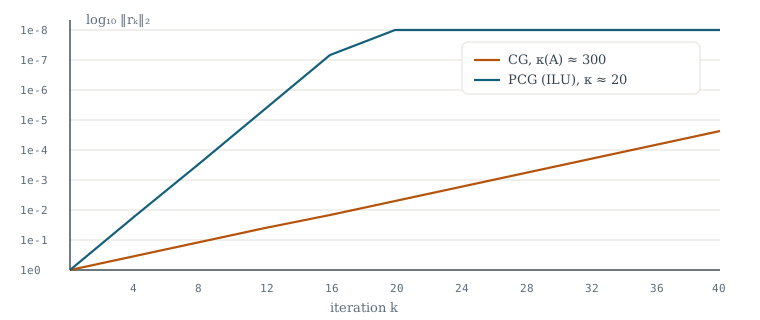
Figure 1. Illustrative residual histories on a model Poisson-type problem: plain CG with κ ≈ 300 against ILU-preconditioned CG with an effective κ ≈ 20.
5 GMRES
The GMRES algorithm (Saad–Schultz, 1986) minimizes the residual norm over x0 + Kk for arbitrary A. Each step appends a column to the Arnoldi factorization and solves a small least-squares problem with a Givens-updated QR factorization. The cost — one vector more of storage and O(k) work per step — grows linearly, so restarted variants (GMRES(m)) cap memory at the price of possibly stagnating convergence. RULES of thumb: nonzero/repeated eigenvalues clustered away from zero mean fast convergence; eigenvalues surrounding the origin in a disk mean trouble.
6 Preconditioning
Everything above solves the system M−1A x = M−1b just as happily, for any easily inverted M. The art of numerical linear algebra is choosing M ≈ A so that M−1A has a friendlier spectrum:
- Jacobi / diagonal: scales row norms; cheap first aid.
- Incomplete factorizations (ILU): drop small entries during a truncated Gaussian elimination.
- Sparse approximate inverse (SPAI): build M directly, robust in parallel.
- Geometric or algebraic multigrid (AMG): for elliptic problems, the only asymptotically optimal choice; roughly O(n) total work.
Modern large-scale solvers — PETSc, Trilinos, hypre — are at heart vast, well-engineered libraries for picking and composing these Ms; see the resources page.
References
- M. R. Hestenes, E. Stiefel, "Methods of conjugate gradients for solving linear systems," J. Res. NBS 49 (1952), 409–436.
- C. C. Paige, M. A. Saunders, "Solution of sparse indefinite systems of linear equations," SIAM J. Numer. Anal. 12 (1975), 617–629.
- Y. Saad, M. H. Schultz, "GMRES: a generalized minimal residual algorithm for solving nonsymmetric linear systems," SIAM J. Sci. Stat. Comput. 7 (1986), 856–869.
- Y. Saad, Iterative Methods for Sparse Linear Systems, 2nd ed., SIAM, 2003.